






Spotlights
Farm Economist, Agribusiness Economist, Agricultural Policy Analyst, Agricultural Data Analyst, Farm Management Economist, Agribusiness Economist
Behind every choice about what farmers grow, how farms are run, or the rules that help farmers, there’s someone who turns tricky information into smart ideas. That someone is an Agricultural Economist. Instead of working in the fields, they study things like land, workers, seeds, and fertilizers to understand how to use them in the best way. They also look at how prices, markets, and government decisions affect farmers and the food we eat.
Instead of planting crops, Agricultural Economists plant ideas! They use math, numbers, and problem-solving skills to guess what might happen in farming and to fix problems like food shortages or high prices. They also help predict food shortages before they happen by studying weather, farming data, and trade, and can warn people if a drought might cause less food to grow, so solutions can be found early!
They help farmers figure out how to save money, advise the government on farming rules, and support companies in setting prices or planning for the future. If you like farming and enjoy solving puzzles using numbers and research, this job could be a great way to help people and feed the world!
- Helping farmers and agribusinesses increase profits by applying smart economic strategies
- Seeing policies or projects you’ve worked on improve food security in communities
- Working on global challenges like sustainability, trade, and resource management
- Blending a passion for agriculture with strong analytical skills to make a real impact
Working Schedule
Agricultural Economists usually work full‑time in offices, research centers, or universities. They often keep regular business hours but may travel to farms, conferences, or government meetings. When deadlines for reports or policy briefs approach, longer hours are common.
Typical Duties
- Analyze economic data related to crop yields, prices, and production costs.
- Prepare reports and forecasts for farmers, agencies, or agribusinesses.
- Develop models to predict how policy changes or market trends will affect agriculture.
- Consult with farming operations to improve efficiency and profitability.
- Present findings to government officials, industry leaders, or academic peers.
Additional Responsibilities
- Designing and conducting surveys to gather farm‑level data.
- Writing grant proposals to fund research projects.
- Advising on crop insurance programs, trade deals, or subsidy impacts.
- Teaching university courses or training new professionals in agricultural economics.
- Staying updated with new analytical software, data sources, and economic models.
- Collaborating with agronomists, policy makers, and sustainability experts on interdisciplinary projects.
- Publishing articles or presenting research at national and international conferences.
Before stepping into meetings or touching a spreadsheet, the day often starts with a scan of global crop prices, overnight rainfall data, and new policy updates that could ripple through the ag economy. From there, it’s a mix of deep analysis and real-world problem-solving—running economic models to assess the impact of fertilizer cost changes, or helping forecast how droughts might affect corn yields.
Afternoons are typically spent writing reports for government agencies, advising agribusiness clients, or speaking with farmers’ groups about financial strategies. And when planting or harvest is underway, don’t be surprised to find economists out in the field, gathering firsthand insights.
As one profile of respected agricultural economist Roger Falcon noted:
“He derived many of his economic insights and policy recommendations from conversations with farmers all around the world … He needed to travel to the field and see firsthand how the crops, farmers, and communities were faring.” — Stanford Magazine
Because in this line of work, the numbers don’t mean much unless they reflect what’s really happening on the ground!
Soft Skills:
- Communication skills
- Analytical thinking
- Problem‑solving
- Collaboration
- Critical reasoning
- Patience
- Integrity
- Creativity
- Decision‑making
- Attention to detail
Technical Skills:
- Advanced statistics and economic modeling
- Data analysis with software like R, SAS, STATA, or Python
- Knowledge of agricultural markets and policies
- GIS (Geographic Information Systems) for mapping resources
- Understanding of farm management systems
- Financial analysis and budgeting
- Research design and survey methods
- Report writing and publication standards
- Policy Economists: Work with government agencies to shape farm subsidies, trade rules, and environmental policies
- Production Economists: Help farmers and agribusinesses improve efficiency and profitability
- Development Economists: Focus on improving food systems in developing countries
- Academic/Research Economists: Teach and conduct research in universities or think tanks
- Government agencies (USDA, Department of Agriculture, local agriculture boards)
- Universities and agricultural research centers
- International development organizations (FAO, World Bank)
- Agribusiness companies and food processors
- Farm credit institutions and consulting firms
Agricultural Economists often juggle multiple projects and tight deadlines. They’re expected to produce clear, accurate analyses even when data is incomplete or rapidly changing. Sometimes travel is required to gather data or meet stakeholders in rural areas. Late nights may happen before policy deadlines or conference presentations. Still, the impact makes it worthwhile—your advice can directly influence farm incomes, trade policies, or food security initiatives.
Economic modeling is becoming more data‑driven, with big data and artificial intelligence offering new insights into farm productivity and sustainability. There’s increasing focus on climate economics—measuring the cost of droughts, floods, and carbon footprints. Sustainability and resource efficiency are hot topics, with economists evaluating how to balance productivity with environmental stewardship. Digital tools now allow real‑time price tracking and predictive analytics, making the role even more dynamic.
Many agricultural economists loved math, puzzles, and analyzing patterns. Some grew up on farms, fascinated by how market prices changed each week. Others enjoyed debate clubs, economics competitions, or helping in family businesses where budgeting and decision‑making were part of daily life.
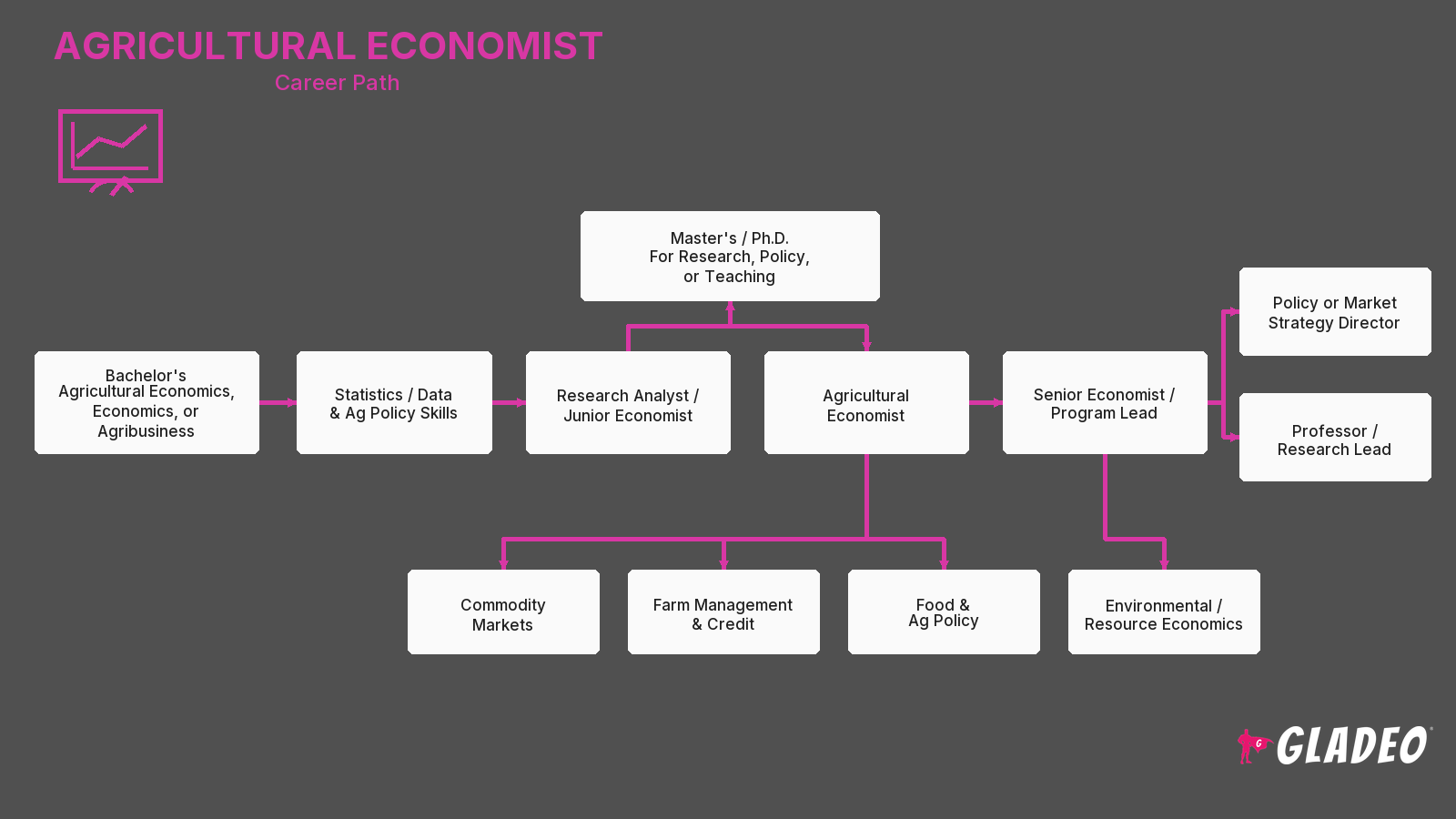
Agricultural Economists generally need at least a bachelor’s degree in agricultural economics, economics, agribusiness, or a related field. These programs teach students how to study agricultural markets, evaluate farming costs and profits, understand food supply and demand, and analyze how government policies and global economic conditions affect agriculture.
A master’s degree may be preferred for advanced research, policy analysis, consulting, or economist positions that involve more complex data analysis. A Ph.D. is often needed for university teaching and independent academic research.
Helpful courses include:
- Agricultural Economics
- Microeconomics and Macroeconomics
- Agricultural Policy and Rural Development
- Farm Management and Agricultural Finance
- Agribusiness and Agricultural Marketing
- International Trade and Development Economics
- Statistics and Econometrics
- Data Analysis and Quantitative Research Methods
- Food Systems and Agricultural Supply Chains
- Environmental and Resource Economics
Students should also develop strong skills in statistical software, spreadsheets, data visualization, and research tools. Agricultural Economists often use these tools to examine crop prices, production costs, trade patterns, consumer behavior, and economic trends.
Practical experience is valuable. Internships with government agricultural agencies, research institutions, universities, agricultural companies, commodity organizations, or international development groups can help students learn how economic research is conducted and applied to real agricultural issues.
- Take classes in economics, business, mathematics, statistics, agriculture, and environmental science.
- Strengthen your math skills, especially algebra, statistics, and data interpretation.
- Learn how to use spreadsheets and data tools to organize information and create charts.
- Follow agricultural and economic news, including food prices, farming costs, international trade, and government policies.
- Join a business, economics, agriculture, or entrepreneurship club.
- Participate in research projects or school activities involving food systems, farming, sustainability, or community development.
- In college, pursue a degree in agricultural economics, economics, agribusiness, or a related field.
- Take electives in econometrics, international trade, environmental economics, public policy, and agricultural finance.
- Learn statistical software and data analysis tools such as R, Python, SAS, or Stata.
- Seek internships with agricultural departments, economic research organizations, universities, agricultural businesses, or international development organizations.
- Look for opportunities to assist professors or researchers with studies involving agricultural markets, rural communities, food security, or farm productivity.
- Build communication and presentation skills so you can explain economic findings clearly to farmers, business leaders, policymakers, and the public.
- A strong curriculum in agricultural economics, economics, statistics, and business.
- Courses in agricultural markets, food systems, farm management, international trade, and agricultural policy.
- Opportunities to learn econometrics, statistical analysis, and economic modeling.
- Training in data analysis software such as R, Python, SAS, or Stata.
- Faculty members with experience in agricultural research, economic policy, or agribusiness.
- Access to research centers, agricultural extension programs, or partnerships with government agencies and agricultural organizations.
- Internship opportunities with agricultural businesses, research institutions, government departments, or international development groups.
- Opportunities to conduct research and work with real agricultural and economic data.
- Career guidance and connections to employers in agriculture, government, consulting, academia, and economic research.
- Search on sites like AgCareers.com, USAJobs.gov, Indeed, or university career portals for positions such as research assistant, economic analyst, or agribusiness trainee. Use keywords like “agricultural economics,” “farm policy,” or “commodity markets” to find the most relevant roles.
- Apply to entry‑level roles at government agencies (such as USDA, state departments of agriculture, or economic development offices), farm credit institutions, cooperatives, think tanks, or consulting firms. Don’t overlook internships or temporary analyst positions because they often lead to full-time roles.
- Highlight any research projects, internships, or farm background experience on your resume.
- Network at agricultural economics conferences, webinars, and alumni events.
- Prepare for interviews by practicing how to explain economic concepts in simple terms.
- Demonstrate your ability to connect data to real agricultural decisions.
- Wear professional attire to interviews and express your passion for agriculture, understanding of crop inputs, and eagerness to grow and learn on the job.
- Specialize in a niche like commodity markets, international trade, or sustainability economics to stand out in the field.
- Pursue advanced degrees (such as a Master’s or Ph.D. in Agricultural Economics) or professional certifications in data analytics, GIS, or risk management to open doors to senior roles.
- Join professional groups such as the Agricultural & Applied Economics Association AAEA or the International Association of Agricultural Economists (IAAE) to network with experts and stay updated on global trends.
- Show leadership by mentoring interns, leading projects, or advising policy groups through university extension programs or nonprofit coalitions.
Stay current with agricultural policy, global trade agreements, and emerging technologies like precision agriculture or ag data platforms.
Take on cross-functional roles that give you experience in budgeting, forecasting, or regulatory compliance to broaden your management skills. - Apply for fellowships or advisory roles with organizations like USDA, IFPRI, or regional economic development councils.
- Build relationships with industry stakeholders, university researchers, and government agencies through webinars, panels, or cooperative research initiatives.
- Seek out professional development through online courses, certificate programs, and feedback from supervisors or mentors to refine your technical and communication skills.
Websites:
- AgCareers.com
- USDA – Economic Research Service
- Agricultural & Applied Economics Association
- FarmProgress
- AgWeb
- AgEcon Search
- CME Group – Agricultural Markets
- IFPRI
- RePEc
- C-FARE
- Farm Credit
- AgriMarketing
- Extension Foundation (eXtension)
- National Agricultural Statistics Service
- USDA – Foreign Agricultural Service
- World Bank – Agriculture and Food
- OECD – Agriculture and Fisheries
- FAO
- NIFA
- Agri-Pulse
Books:
- Agricultural Economics by H. Evan Drummond and John W. Goodwin
- The Economics of Food and Agricultural Markets by Andrew Barkley and Paul W. Barkley
- Applied Agricultural Economics by Allen W. Barkema
If becoming an Agricultural Economist doesn’t feel like the perfect fit, there are plenty of rewarding and closely related careers where you can apply the same analytical, business, and agricultural knowledge. These alternative paths still let you make an impact on the food system, rural development, and resource management while offering different work environments, specialties, or responsibilities:
- Agribusiness Consultant
- Farm Credit Loan Officer
- Market Research Analyst (Agriculture)
- Agricultural Policy Advisor
- Supply Chain Analyst
- Farm Manager
Newsfeed

Featured Jobs
Online Courses and Tools