






Spotlights
Agricultural Systems Specialist, Conservation Engineer, Engineer, Product Engineer, Product Technology Scientist, Project Engineer, Research Agricultural Engineer
Agriculture is a trillion-dollar business and a huge part of our nation’s economy. It’s also much more complex than most people realize. There are numerous machines, equipment, power supplies, irrigation systems, and facilities to take care of, requiring the skills of an Agricultural Engineer.
Agricultural Engineers apply engineering principles to improve the sustainability and productivity of processes, equipment, and systems. This includes environmental management, to reduce pollution and harmful effects on ecosystems. They also help integrate automation and robotics into agribusiness operations, study soil fertility and nutrient content, estimate potential crop yields, and optimize food processing methods.
In short, though they work in a relatively small career field, their insights, knowledge, skills, and services are invaluable to society!
- Improving agribusiness processes to benefit owners, consumers, and the environment
- Being part of a massive sector that’s vital to the economy and the food supply chain
- Working in a lucrative, specialized niche with great career opportunities
- Impacting the financial health and stability of rural communities
Working Schedule
Agricultural Engineers work full-time jobs, typically with nights, weekends, and holidays off. Overtime may be needed to meet deadlines. Occasional travel and exposure to inclement weather may be necessary.
Typical Duties
- Work with farmers, seafood farmers, forestry professionals, and food processing teams on various projects
- Meet with employers, clients, contractors, developers, city representatives, and fellow engineers to review projects, goals, timeframes, and costs
- Create proposals, presentations, graphics, budgets, and reports for projects
- Use computer-aided drafting programs to design agricultural equipment, irrigation systems, climate control systems, facilities, sensor devices, layouts, parts, etc.
- Work with artificial intelligence and geospatial systems to improve and automate processes
- Design methods to alter and maximize where sun, rain, and wind affect fields and structures
- Assist with creating more efficient climate control and refrigeration systems, facilities for food and crop processing and storage, animal housing, land reclamation projects, and more
- Provide guidance and oversight for new construction projects (such as electric-power distribution systems, irrigation, or flood control systems), new mechanical systems, or production plant operations
- Offer expert advice regarding water quality issues, pollution management, and resource utilization
Additional Responsibilities
- Quality test machines and equipment for performance and safety
- Conduct site visits and offer consultations
- Train and mentor team members, as needed
- Maintain good relations with local farmers, agribusiness owners, industry associations, and related organizations or agencies
- Create or present educational materials to farmers or farm co-ops to enhance sustainability
- Research and develop new technologies and potential capabilities
- Stay up to date on manufacturers’ manuals, federal and state regulations, industry changes, and technological advancements
- Attend professional organization events to share information and learn from others
An Agricultural Engineer’s day often begins with reviewing project plans, checking equipment performance, and discussing current challenges with farmers, agricultural specialists, or other engineers. Depending on the project, they may be working on a more efficient irrigation system, designing machinery for harvesting crops, improving farm buildings, or developing technology that reduces water and energy use. They may visit farms or agricultural facilities to inspect equipment, evaluate soil and water conditions, take measurements, and understand how existing systems are working. For example, an Agricultural Engineer helping a farm improve its irrigation system might examine water flow, test pumps, and identify ways to distribute water more evenly across the fields.
Later in the day, they may work in an office, laboratory, or workshop using computer-aided design (CAD) software and engineering tools to develop or improve agricultural equipment and systems. They might create designs for a greenhouse ventilation system, test a new grain-handling machine, analyze data from soil and water sensors, or calculate the strength and safety of a farm structure. They also collaborate with mechanical, electrical, civil, and environmental engineers, as well as farmers and agricultural scientists, to make sure their designs are practical, safe, and cost-effective. Some projects involve building prototypes and testing them under real farming conditions before recommending improvements.
Before the day ends, Agricultural Engineers document their findings, update project reports, review budgets, and communicate progress to clients or team members. They may recommend changes to machinery, irrigation methods, drainage systems, or food-processing equipment to improve productivity and reduce waste. Some engineers spend much of their time in offices or laboratories, while others regularly travel to farms, factories, construction sites, and agricultural research facilities. Their schedules can vary depending on project deadlines, equipment problems, and seasonal farming activities. Their work helps make agriculture more productive, sustainable, and efficient.
Soft Skills
- Activities Coordination
- Analytical
- Attention to detail
- Business acumen
- Collaboration
- Creativity
- Critical thinking
- Decisive
- Deductive and inductive reasoning
- Detail-oriented
- Independent
- Monitoring
- Objective
- Organized
- Patient
- Perceptive
- Problem-solving
- Reading comprehension
- Safety-oriented
- Strong communication skills
- Visualization
Technical Skills
- Computer-aided design
- Engineering and technology
- Familiarity with applicable federal and state regulations
- Knowledge of fabrication and manufacturing
- Knowledge of the agricultural sector
- Mechanical aptitude
- Operations analysis
- Risk assessment principles
- Strong science and math skills
- Farm Machinery Engineer: Designs, tests, and improves agricultural machines such as tractors, planters, harvesters, and other equipment used in farming operations.
- Irrigation Engineer: Develops irrigation systems that deliver water efficiently to crops, including drip irrigation, sprinklers, pumps, and automated watering systems.
- Soil and Water Conservation Engineer: Designs systems and practices that help prevent soil erosion, manage runoff, protect water resources, and maintain healthy farmland.
- Agricultural Structures Engineer: Designs and evaluates farm buildings and facilities, including barns, greenhouses, storage buildings, livestock housing, and grain silos.
- Bioprocessing Engineer: Develops equipment and processes for converting agricultural materials, crops, and organic waste into useful products such as biofuels, food ingredients, and other bioproducts.
- Food Process Engineer: Designs and improves machinery, production systems, and processing methods used to handle, preserve, package, and store agricultural products.
- - Environmental Agricultural Engineer: Develops solutions to reduce the environmental impact of farming, including systems for managing animal waste, controlling pollution, and improving resource efficiency.
- Precision Agriculture Engineer: Uses GPS, sensors, drones, robotics, and data systems to help farmers monitor crops, operate equipment accurately, and make better decisions about planting, watering, and fertilizing.
- Agricultural Automation Engineer: Designs and improves automated equipment and robotic systems that perform farming tasks such as planting, harvesting, sorting, and monitoring crops.
- Post-Harvest Systems Engineer: Develops technologies and facilities for drying, cooling, handling, transporting, and storing crops to reduce spoilage and maintain product quality.
- Governmental agencies
- Educational institutions
- Consulting service and engineering agencies
The work of Agricultural Engineers is vital for helping agribusinesses improve efficiency and become more sustainable. The national economy—and all food consumers—depend greatly on the success of such businesses.
Surrounding rural communities are also deeply affected by how well local farms and agribusinesses are doing. Meanwhile, local citizens in general often take a keen interest in environmental and food safety issues. Suffice it to say, Agricultural Engineers carry a lot of responsibility on their shoulders!
The agricultural sector is continuously impacted by climate and environmental factors that affect crop production, exacerbate costs, and may result in economic losses. Agricultural Engineers do their best to assist these businesses as they try to adapt to changes. Part of this includes helping them be more “climate-smart” by incorporating sustainable, environmentally-friendly equipment, machines, systems, and processes.
Agricultural Engineers assist with designing and adopting automation and robotics technologies; leveraging the power of data-gathering sensors and the Internet of Things; creating more climate-resilient infrastructures and better water management strategies; helping build robust food safety protocols; and devising strategies to reduce waste and create circular economies.
Agricultural Engineers may have shown early interest in science, nature, plants and animals, or building and tinkering with things. Many grow up in rural areas and are exposed to farming and gardening at a young age. Others simply love STEM-related activities and want to apply what they learn to improve the world around them!
Agricultural Engineers generally need a bachelor’s degree in agricultural engineering, biological engineering, or a closely related engineering field. These programs combine engineering principles with knowledge of agriculture, biology, and environmental science. Students learn how to design, develop, test, and improve equipment and systems used in farming, food production, water management, and other agricultural operations.
Helpful courses include:
- Agricultural Engineering
- Mechanical Engineering Fundamentals
- Soil and Water Science
- Irrigation and Drainage Engineering
- Hydraulics and Fluid Mechanics
- Engineering Mechanics and Materials
- Electrical Circuits and Electronics
- Thermodynamics and Energy Systems
- Environmental Engineering
- Agricultural Machinery and Equipment
- Computer-Aided Design (CAD)
- Robotics, Automation, and Precision Agriculture
- Mathematics, Physics, and Statistics
Students should also develop computer skills, particularly in CAD software, engineering simulations, data analysis, and equipment-control systems. Depending on their specialization, they may work with geographic information systems (GIS), sensors, drones, robotics, or automated irrigation technologies.
Practical experience is an important part of training. Many programs include laboratory work, engineering design projects, fieldwork, and internships where students can apply what they learn to real agricultural problems. They may work with farms, equipment manufacturers, agricultural research centers, irrigation companies, food-processing facilities, or government agencies.
In the United States, Agricultural Engineers who offer engineering services directly to the public may need to obtain a Professional Engineer (PE) license. Requirements vary by state but generally involve graduating from an accredited engineering program, passing the Fundamentals of Engineering (FE) exam, gaining qualifying work experience, and passing the Principles and Practice of Engineering (PE) exam. Licensure is not required for every agricultural engineering position.
- Take classes in algebra, geometry, trigonometry, calculus, physics, chemistry, and biology.
- Develop an interest in agriculture, environmental science, and how machines and technology are used in farming.
- Join science, engineering, robotics, or agricultural clubs.
- Participate in science fairs or engineering competitions involving irrigation, renewable energy, automation, or agricultural technology.
- Learn basic computer-aided design (CAD), programming, and spreadsheet skills.
- Visit farms, agricultural facilities, or equipment demonstrations to understand real-world farming challenges.
- In college, pursue a degree in agricultural engineering, biological engineering, or a related engineering discipline.
- Take electives in robotics, precision agriculture, renewable energy, environmental engineering, and water resource management.
- Participate in engineering design projects, laboratory experiments, and research involving agricultural equipment or systems.
- Learn to use CAD and engineering software for designing and testing machinery, structures, and irrigation systems.
- Seek internships or summer jobs with agricultural equipment manufacturers, engineering firms, farms, irrigation companies, food-processing facilities, or government agencies.
- Work on projects that develop practical solutions to agricultural problems, such as reducing water consumption, improving harvesting equipment, or managing agricultural waste.
- Build communication, teamwork, and problem-solving skills by collaborating with students and professionals from different engineering and agricultural fields.
- Accreditation from ABET or another recognized engineering accreditation organization, especially if you plan to pursue professional engineering licensure in the United States.
- A strong curriculum covering engineering fundamentals, agriculture, biology, and environmental science.
- Courses in agricultural machinery, irrigation, drainage, soil and water conservation, and agricultural structures.
- Access to well-equipped engineering laboratories, workshops, testing facilities, and agricultural research farms.
- Opportunities to learn CAD software, robotics, automation, GIS, and precision agriculture technologies
- Hands-on projects that allow students to design, build, test, and improve agricultural equipment and systems.
- Internship or cooperative education opportunities with agricultural businesses, engineering firms, equipment manufacturers, and government agencies.
- Faculty members with experience in agricultural engineering research and real-world industry projects
- Opportunities to specialize in areas such as farm machinery, water resources, food processing, environmental engineering, or agricultural automation.
- Career services and professional connections that can help graduates find employment in engineering, agriculture, manufacturing, and research.
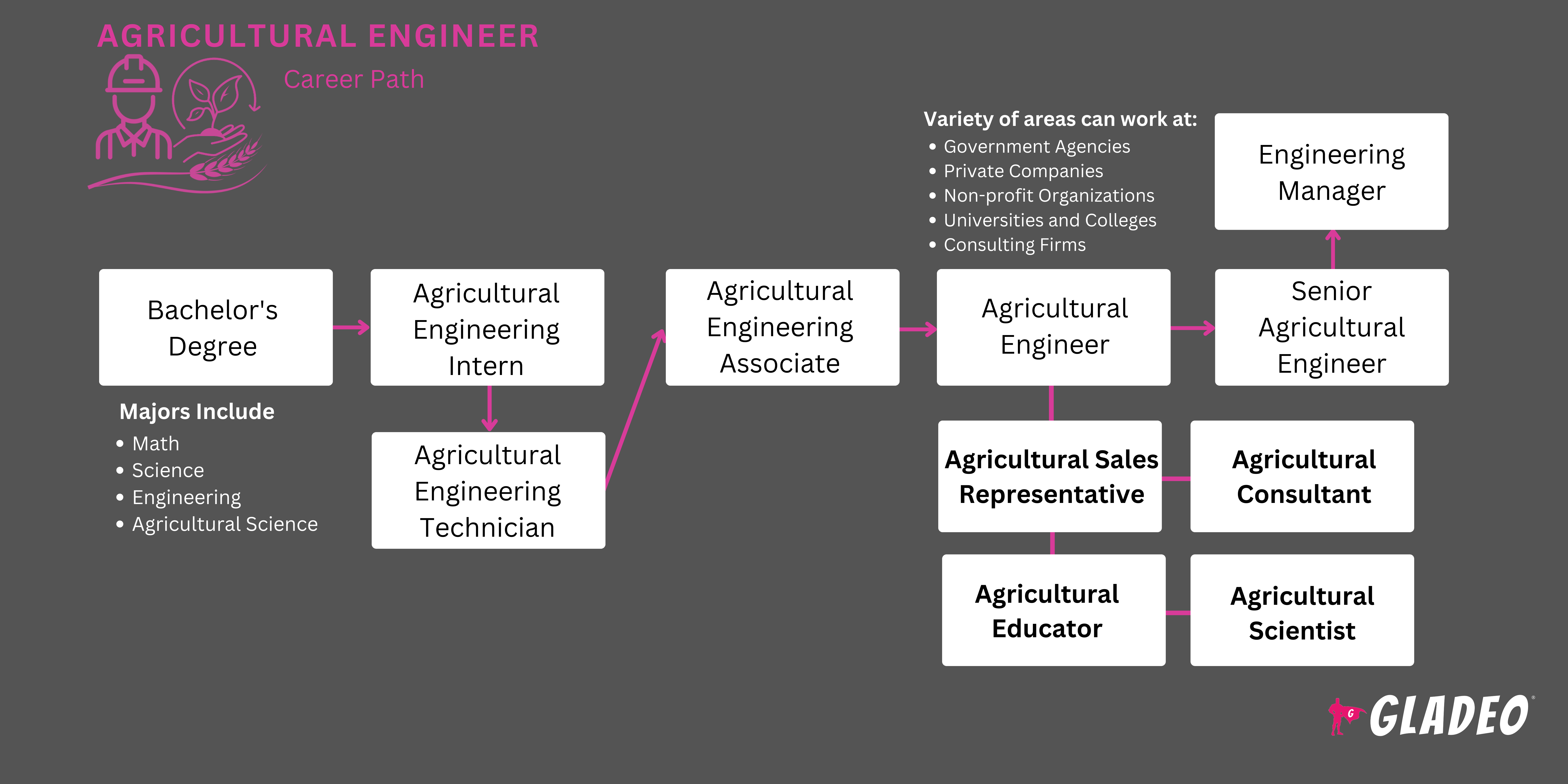
- Check out job portals like Indeed.com, LinkedIn, Glassdoor, Monster, CareerBuilder, SimplyHired, or ZipRecruiter
- Also look at AgCareers, AgHires, Farm Job Search, EcoFarm, Farm and Ranch Jobs, USDA Jobs, and related sites
- Consider relocating to a rural area where there are farms and agribusinesses
- Let your network know you’re looking for work. Most jobs are still found through personal connections—plus, this is not a big career field!
- Ask your instructors, former supervisors, and/or coworkers if they’re willing to serve as personal references. Don’t give out their personal contact information without prior permission
- Check out some Agricultural Engineer resume examples and sample interview questions such as “Which techniques have you used to extract toxic elements from the soil?” or “How do you communicate with stakeholders to change perspectives on organic varieties of existing crops?”
- Practice doing mock interviews with your school’s career center (if they have one)
- Dress appropriately for interviews and show your enthusiasm for and knowledge of the field
- Communicate regularly with leadership and stakeholders to ensure objectives and timeframes are clearly defined and achievable. Don’t make promises you can’t keep!
- Use your industry knowledge to anticipate and mitigate issues before they become problems
- Speak with colleagues working in other agribusinesses to exchange information and tips (when possible. Some information may be proprietary or otherwise restricted)
- Solve tough challenges for your employer. Add tangible value by boosting efficiency, productivity, and sustainability
- Have a contingency plan to respond to critical issues quickly and decisively
- Study trends and advances in applicable technologies, equipment, and processes
- Participate in professional organizations like the American Society of Agricultural and Biological Engineers. Keep learning and expanding your knowledge base and skills
- Collaborate effectively with team members and develop strong relationships with local farmers, agribusiness owners, and other stakeholders in the community
- Don’t be shy! Speak with your boss about career progression
- Knock out a specialty certification such as the American Society for Quality’s Certified Reliability Engineer or the American Society of Agronomy’s Certified Crop Advisor and Certified Professional Agronomist
- Complete a graduate degree such as a Master of Science in Agriculture or a Master of Engineering
- Earn your Professional Engineering license
- Consider applying to work for a larger organization with more advancement opportunities
Websites
- ABET
- American Geophysical Union
- American Society for Engineering Education
- American Society of Agricultural and Biological Engineers
- American Society of Agronomy
- American Society of Civil Engineers
- American Society of Irrigation Consultants
- Association for International Agriculture and Rural Development
- Future Farmers of America
- Irrigation Association
- Journal of Agricultural Engineering
- National Council of Examiners for Engineering and Surveying
- National Institute for Certification in Engineering Technologies
- National Institute of Food and Agriculture, U.S. Department of Agriculture
- National Society of Professional Engineers
- U.S. Food and Drug Administration
Books
- Agricultural Engineering and Feeding the Future, by Anne Rooney
- Introduction to Agricultural Engineering Technology: A Problem-Solving Approach, by Harry L. Field and John M. Long
- Rainwater Harvesting For Irrigation: Discover Everything You Need to Master Rainwater Harvesting in Your Garden or Farm, by Melanie Davis
Agricultural Engineering is a vital but relatively small field. The current job outlook from the Bureau of Labor Statistics does not suggest much growth in the coming years. This means that to find work, you may have to wait for a currently-working Agricultural Engineer to retire!
If you’re curious about related career options, consider the below similar occupations:
- Agricultural or Food Scientist
- Architectural and Engineering Manager
- Biofuels Production Manager
- Civil Engineer
- Conservation Scientist
- Environmental Engineer
- Farmer/Rancher
- Hydrologist
- Industrial Engineer
- Mechanical Engineer
Newsfeed

Featured Jobs
Online Courses and Tools
Annual Salary Expectations
New workers start around $84K. Median pay is $104K per year. Highly experienced workers can earn around $128K.
Annual Salary Expectations
New workers start around $88K. Median pay is $102K per year. Highly experienced workers can earn around $128K.