






Spotlights
Environmental Attorney, Environmental Litigation Attorney, Environmental Compliance Attorney, Natural Resources Attorney, Climate Policy Attorney, Land Use Attorney, Environmental Regulatory Counsel, Public Interest Environmental Lawyer, Environmental Law Associate, Conservation Attorney, Energy and Environmental Attorney
A river turns a strange color overnight, a wetland gets bulldozed for a parking lot, a company quietly dumps chemicals where nobody is supposed to be looking. Someone has to notice, prove it, and force a change. That someone is often an Environmental Lawyer, using the law as a tool to protect air, water, land, and the people and wildlife that depend on them.
Environmental Lawyers represent clients in disputes and decisions that touch the natural world, from a nonprofit suing to block a polluting factory to a city defending its zoning rules to a corporation trying to stay on the right side of clean air and water regulations. They dig through scientific reports, interview experts, draft legal filings, and argue in front of judges, agencies, and legislators. Some spend their days negotiating settlements over contaminated land; others spend it fighting for stronger climate rules or defending an endangered species' habitat from development.
Armed with statutes, case law, environmental impact reports, and testimony from scientists and engineers, Environmental Lawyers translate complicated science and policy into arguments that hold up in court and in the halls of government. Their work shapes what gets built, what gets cleaned up, and what gets protected for the next generation, making them one of the few professions where a single case can change the landscape, literally.
- Standing up for communities, ecosystems, and future generations who cannot argue for themselves in court
- Turning complex science into arguments that actually change laws and policies
- Working on cases that leave a visible, lasting mark on the world around you
- Combining a love of the outdoors with a sharp legal mind and a sense of purpose
Working Schedule
Environmental Lawyers generally work full-time, and many put in extra hours when a case is heading to trial, a regulatory deadline is looming, or a client needs an urgent response to a spill or violation notice. Most work from an office or law firm, though site visits to contaminated properties, construction sites, or natural areas are common, along with travel to courtrooms, agency hearings, and client meetings. Some work for private law firms, some for government agencies, and some for nonprofits and advocacy groups, each with a different rhythm and set of pressures.
Typical Duties
- Researching environmental statutes, regulations, and case law relevant to a client's situation
- Reviewing environmental impact statements and scientific reports
- Drafting legal briefs, motions, contracts, and regulatory comments
- Representing clients in court, at administrative hearings, and in negotiations
- Advising companies on how to comply with environmental laws and permits
- Investigating potential violations of pollution, land use, or wildlife protection laws
- Working with scientists, engineers, and expert witnesses to build a case
- Negotiating settlements in pollution, contamination, or land use disputes
- Communicating with clients about legal risks and strategy
- Filing lawsuits or defending against them on behalf of clients
- Tracking new legislation and regulatory changes that affect clients
- Preparing testimony for legislative hearings on environmental policy
Additional Responsibilities
- Mentoring junior attorneys and law clerks
- Collaborating with policy teams at nonprofits or government agencies
- Writing articles, opinion pieces, or public comments on environmental issues
- Building relationships with regulators, community groups, and industry contacts
- Managing case files, deadlines, and billing for multiple matters at once
- Speaking at conferences or community meetings about environmental law
- Staying current on climate science and emerging environmental technology
- Volunteering with pro bono environmental cases or legal clinics
Mornings often start with checking case deadlines and reading through overnight emails from clients, opposing counsel, or regulatory agencies. An Environmental Lawyer might spend the first part of the day reviewing a stack of scientific data on groundwater contamination or drafting a motion for an upcoming hearing, making sure every legal argument is backed by solid evidence.
Midday often brings meetings, whether that is a call with a client worried about a new permit requirement, a strategy session with the legal team about an upcoming trial, or a site visit to see firsthand the wetland or facility at the center of a case. Environmental Lawyers frequently coordinate with scientists and engineers during this part of the day to make sure the technical details of a case are airtight.
Afternoons and evenings might involve negotiating with opposing counsel, preparing witnesses for testimony, or responding to a breaking situation like a chemical spill that needs immediate legal action. Many Environmental Lawyers also spend time tracking pending legislation or regulatory changes, since new rules can reshape a case or a client's obligations overnight.
Soft Skills
- Persuasive writing and speaking
- Critical thinking and analytical reasoning
- Negotiation and conflict resolution
- Attention to detail
- Resilience and patience through long legal processes
- Strong ethics and integrity
- Comfort with public speaking and courtroom presence
- Ability to translate complex science for non-experts
- Collaboration with scientists, policymakers, and communities
- Time management across multiple cases
- Curiosity about environmental science and policy
- Empathy for communities affected by environmental harm
Technical Skills
- Knowledge of environmental statutes such as the Clean Air Act, Clean Water Act, and Endangered Species Act
- Legal research using databases like Westlaw or LexisNexis
- Understanding of environmental science, toxicology, and ecology basics
- Drafting contracts, briefs, and regulatory filings
- Familiarity with administrative law and agency rulemaking procedures
- Litigation skills, including discovery, depositions, and trial advocacy
- Reading and interpreting environmental impact assessments
- Basic understanding of GIS mapping and environmental data
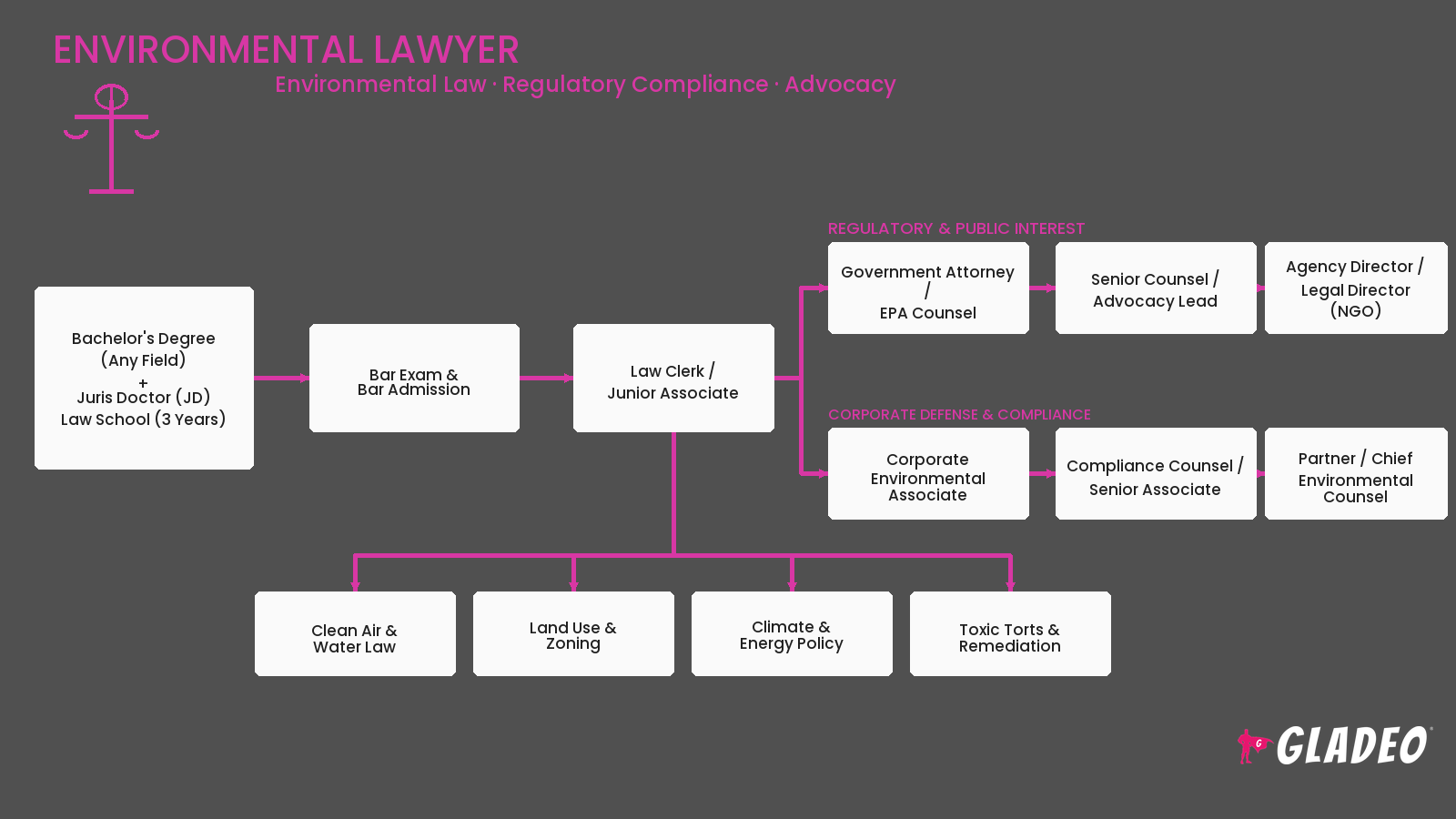
- Litigation Attorney: Represents clients in court over pollution, contamination, or land disputes
- Regulatory Compliance Attorney: Helps companies meet environmental laws and avoid violations
- Policy Attorney: Works on drafting and shaping environmental legislation and regulations
- Land Use Attorney: Focuses on zoning, development, and conservation of land
- Climate Attorney: Specializes in climate change litigation and clean energy policy
- Natural Resources Attorney: Handles cases involving water rights, mining, and public lands
- Corporate Environmental Counsel: Advises businesses on environmental risk and compliance in-house
- Public Interest Attorney: Represents communities and nonprofits fighting environmental harm
- Private law firms with environmental practice groups
- Government environmental agencies
- Environmental nonprofits and advocacy organizations
- Corporate legal departments in energy, manufacturing, or agriculture
- Law school environmental legal clinics
- International environmental organizations
- Tribal governments and land management agencies
- Utility and energy companies
- Real estate and land development firms
- Consulting firms specializing in environmental compliance
Environmental Lawyers often work on cases that unfold over years, requiring patience through slow-moving litigation, appeals, and regulatory processes even when the underlying environmental harm feels urgent. Losing a case can mean watching a habitat get destroyed or a community continue living with pollution, which can be emotionally difficult.
The hours can be demanding, especially in the run-up to trial or when responding to a sudden environmental emergency like a spill or a fast-moving permit deadline. Lawyers in this field also face pressure from powerful opposing parties, since environmental cases frequently pit individuals or small nonprofits against large corporations or government agencies with far more resources.
The work also requires constant learning, since science, technology, and regulations in this field change quickly. Staying credible in court means staying current, which often means reading dense scientific studies and new case law on top of an already full caseload.
- Rising litigation over climate change, carbon emissions, and corporate climate disclosures
- Growing use of environmental, social, and governance (ESG) standards in corporate law
- Increased focus on environmental justice and pollution's impact on low-income communities
- Expansion of renewable energy projects creating new permitting and land use disputes
- Greater use of satellite data and GIS technology as evidence in environmental cases
- More states adopting their own climate and clean energy legislation
- Growing corporate demand for environmental compliance counsel
- Increased attention to water rights and drought-related legal disputes
- Rise of international environmental law and cross-border pollution cases
- More collaboration between environmental lawyers and data scientists
Many Environmental Lawyers grew up spending time outdoors, hiking, camping, fishing, or exploring nature, and developed a strong sense of wanting to protect the places they loved. Some were the kids organizing recycling drives, joining environmental clubs, or arguing passionately about fairness and justice at the dinner table.
Others were drawn to debate team, mock trial, or student government, enjoying the process of building an argument and convincing others. A combination of caring deeply about the environment and enjoying the structure and strategy of an argument often pointed these students toward law as the tool that could make their passion for the planet actually count for something.
Becoming an Environmental Lawyer starts with a four-year bachelor's degree, often in environmental science, political science, biology, or a related field, followed by three years of law school to earn a Juris Doctor (J.D.) degree. After law school, graduates must pass the bar exam in the state where they plan to practice. Many students strengthen their path by focusing on environmental law coursework, clinics, and internships during law school.
Students can take courses in relevant subjects such as:
- Environmental Science
- Environmental Law and Policy
- Constitutional Law
- Administrative Law
- Natural Resources Law
- Political Science
- Public Speaking and Debate
- Ecology and Biology
- Statistics and Data Analysis
- Business or Corporate Law
Hands-on experience through internships at environmental agencies, law firms, or nonprofits gives students a real sense of how environmental law works outside the classroom. Participating in law school environmental clinics, moot court, or mock trial builds practical litigation skills before graduation. Many aspiring Environmental Lawyers also gain valuable perspective by working or volunteering with conservation groups before or during law school.
- Join debate team, mock trial, or Model UN to build persuasive speaking and argument skills
- Take environmental science, biology, and government or civics classes
- Volunteer with local conservation groups, clean-up efforts, or environmental clubs
- Read about landmark environmental court cases and current environmental legislation
- Practice research and writing skills through school papers and projects
- Attend a town hall or public hearing on a local environmental issue
- Seek internships at law firms, government agencies, or environmental nonprofits
- Talk to practicing Environmental Lawyers about their career path
- Take the LSAT seriously and prepare well in advance
- Build strong relationships with teachers who can write compelling recommendation letters
- Get involved in student government or advocacy campaigns
- Study a foreign language, which can be valuable for international environmental work
- Law schools with a dedicated environmental law program, clinic, or center
- Strong placement records for environmental law internships and clerkships
- Faculty who actively practice or research environmental law
- Opportunities to participate in moot court or environmental law journals
- Access to legal research resources like Westlaw and LexisNexis
- Strong bar passage rates in the state where you plan to practice
- Career services with connections to environmental firms, agencies, and nonprofits
- Flexible course offerings that combine science and legal coursework
- Opportunities for pro bono or public interest legal work
- Alumni networks active in environmental law fields
- Programs that support externships with judges or government agencies
- Reasonable tuition relative to expected starting salary in public interest law
- Complete at least one internship or clerkship with an environmental law firm, agency, or nonprofit
- Participate in your law school's environmental law clinic for hands-on casework
- Network with attorneys through your school's environmental law society or bar association
- Attend environmental law conferences and career fairs
- Apply for judicial clerkships to build litigation experience and professional connections
- Tailor your resume to highlight environmental science background alongside legal training
- Search job boards focused on legal and public interest careers
- Consider starting in a government agency to build regulatory expertise
- Reach out to alumni working in environmental law for informational interviews
- Prepare a strong, specific cover letter explaining why environmental law matters to you
- Practice interview answers about your legal reasoning on real environmental issues
- Be open to relocating for opportunities with strong environmental law markets
- Build a track record of successful cases or well-regarded regulatory filings
- Develop a specialty, such as climate litigation, land use, or corporate compliance
- Publish articles or speak at conferences to build a reputation in the field
- Take on leadership roles within professional associations
- Mentor law students and junior attorneys
- Pursue partnership tracks at firms or leadership roles at nonprofits and agencies
- Build long-term relationships with clients, regulators, and community organizations
- Stay current on emerging environmental science and policy to remain a trusted expert
Websites:
- Environmental Law Institute - eli.org
- Natural Resources Defense Council - nrdc.org
- Earthjustice - earthjustice.org
- American Bar Association Section of Environment, Energy, and Resources - americanbar.org
- Environmental Protection Agency - epa.gov
- Sierra Club Environmental Law Program - sierraclub.org
- Center for International Environmental Law - ciel.org
- Environmental Law Reporter - eli.org/elr
- Vermont Law and Graduate School Environmental Law Center - vermontlaw.edu
- Georgetown Environmental Law & Policy Program - law.georgetown.edu
- Yale School of the Environment - environment.yale.edu
- Union of Concerned Scientists - ucsusa.org
Books:
- Silent Spring by Rachel Carson
- The Environmental Law Handbook by Thomas F.P. Sullivan
- Law of the Land by Robert V. Percival
- A Civil Action by Jonathan Harr
- Environmental Law and Policy by Robert V. Percival, Christopher H. Schroeder, and Alan S. Miller
If you find that being an Environmental Lawyer isn't the right fit, your skills in advocacy, research, and environmental science can carry you into many related careers.
- Environmental Policy Analyst
- Environmental Consultant
- Legislative Aide
- Environmental Compliance Officer
- Land Use Planner
- Environmental Scientist
- Nonprofit Program Director
- Corporate Sustainability Manager
- Paralegal specializing in environmental law
- Natural Resources Manager
Newsfeed

Featured Jobs
Online Courses and Tools