





Spotlights
Natural Language Processing Engineer, Computational Linguist, Text Mining Specialist, Language AI Engineer, NLP Research Engineer, Speech and Language Technologist, Text Analytics Engineer, Applied NLP Scientist, Language Technology Engineer, Conversational AI Engineer
Autocorrect fixing your typo before you notice it, a translation app turning a foreign menu into English in real time, a voice assistant understanding "set a timer for ten minutes" no matter how you phrase it, or a spam filter catching a phishing email written to sound legitimate, all of it depends on software that can make sense of human language. Teaching a computer to understand something as messy, ambiguous, and constantly evolving as language is the specialty of the NLP Specialist.
NLP Specialists build and fine-tune models for a specific language task, whether that is classifying text by topic, detecting sentiment in customer reviews, translating between languages, recognizing names and places in a document, or summarizing a long article into a few sentences. They work closely with linguists, data annotators, machine learning engineers, and product teams to define exactly what "understanding" the language correctly looks like for a given application, then build and test models until they reliably get it right.
Using tools like Python, Hugging Face Transformers, spaCy, and NLTK, along with techniques like tokenization, embeddings, and careful evaluation with metrics such as BLEU and F1 scores, NLP Specialists turn raw text and speech into structured information a computer can act on. Their work breaks down language barriers, helps companies actually understand what customers are saying, and protects people from scams and harmful content hidden in plain language.
- Teaching a computer to understand the subtlety, slang, and nuance of real human language
- Helping people communicate across languages and cultures more easily
- Combining a love of language with hands-on technical problem solving
- Building tools that catch harmful content or make information more accessible to everyone
Working Schedule
Most NLP Specialists work full-time, typically standard business hours, though deadlines around model launches or major product releases can require extra hours. The work is almost entirely computer-based, split between writing code, analyzing text data, and meeting with linguists, annotators, and product teams. Most NLP Specialists are employed by technology companies, but many also work in industries like finance, healthcare, media, and customer service, where understanding text and speech at scale is valuable.
Typical Duties
- Cleaning and preprocessing text data through tokenization and normalization
- Building and fine-tuning models for tasks like classification, sentiment analysis, or entity recognition
- Evaluating model performance using language-specific metrics like F1 score or BLEU
- Building pipelines that handle multiple languages and dialects
- Designing annotation guidelines so human labelers tag text consistently
- Conducting error analysis on tricky language cases like slang, sarcasm, or regional dialects
- Integrating NLP models into applications through APIs and services
- Comparing different model architectures to find the best fit for a task
- Collaborating with linguists and data annotators to improve training data quality
- Staying current on new language model releases and research techniques
- Documenting model behavior, limitations, and known failure cases
Additional Responsibilities
- Supporting other teams building text-based features across a product
- Curating and cleaning large text datasets for training and evaluation
- Investigating and addressing bias or unfairness in language model outputs
- Contributing improvements back to open-source NLP libraries and tools
- Presenting research findings and model performance to stakeholders
- Mentoring annotators and junior team members on labeling standards
An NLP Specialist's day often starts with reviewing model evaluation results from an overnight training run, checking accuracy scores and scanning specific examples where the model got something wrong. Understanding why a mistake happened, whether it was a data problem or a genuine model limitation, shapes the rest of the day's priorities.
Midday is usually spent building and testing. That might mean fine-tuning a model on a new batch of labeled data, writing code to clean up messy text from social media or customer support tickets, or experimenting with a different model architecture to see if it handles slang or sarcasm better. There are often meetings with annotators to clarify labeling guidelines or with product teams to define what "correct" looks like for a tricky edge case.
Afternoons often involve digging into error patterns across a large dataset, writing up findings, and planning the next round of experiments. NLP Specialists also spend time reading recent research to see if a new technique might solve a persistent problem, since the field changes quickly and yesterday's best approach is often improved on within months.
Soft Skills
- A genuine love of language, wordplay, and how meaning shifts with context
- Attention to nuance and ambiguity in written and spoken communication
- Analytical thinking to trace errors back to their root cause
- Patience with messy, inconsistent, real-world text data
- Curiosity about different cultures, dialects, and ways of speaking
- Clear communication of technical results to non-technical teammates
- Collaboration with linguists, annotators, and engineers
- Creativity in designing solutions for ambiguous language problems
- Adaptability as new models and techniques emerge constantly
- Persistence through repeated rounds of testing and refinement
- Cultural sensitivity when working with multilingual or dialect-rich data
Technical Skills
- Python programming for data processing and model development
- Hugging Face Transformers for building and fine-tuning language models
- spaCy and NLTK for text processing and linguistic analysis
- PyTorch or TensorFlow for deep learning model development
- Tokenization and embedding techniques for representing text numerically
- Regular expressions for pattern matching in text
- SQL for querying and managing text datasets
- Evaluation metrics such as BLEU, ROUGE, and F1 score
- Understanding of syntax, semantics, and basic linguistics
- Comfort working with cloud computing and GPU resources for training
- Sentiment Analysis Specialist: Builds models that detect emotion and opinion in text
- Machine Translation Engineer: Builds systems that translate between languages
- Named Entity Recognition Specialist: Builds models that identify people, places, and organizations in text
- Text Classification Engineer: Builds models that sort text into categories like topic or intent
- Speech and Language Specialist: Works on models that convert speech to text and back
- Chatbot and Dialogue Systems Specialist: Builds models that hold multi-turn conversations
- Multilingual and Localization NLP Engineer: Adapts language models to work across many languages
- Technology and software companies
- Social media and communications platforms
- Customer service and support technology companies
- Financial services and fintech companies
- Healthcare and biotechnology companies
- Media, publishing, and content moderation companies
- E-commerce and retail companies
- Translation and localization service providers
- Government agencies and intelligence organizations
- Research labs and universities
- Legal technology companies
- Nonprofit organizations focused on language accessibility
Language is messy, and NLP Specialists are expected to make sense of it anyway. Slang, sarcasm, typos, mixed languages, and constantly evolving internet speech all make "understanding" a moving target, and a model that works well today may need retraining tomorrow as language shifts.
Making sure a model performs fairly across dialects, accents, and languages, including ones with far less training data available, takes extra care and can slow projects down. There is real pressure to get this right, since a model that works well only for one dialect or demographic can unintentionally exclude or misrepresent others.
The field also moves quickly, with new language models and techniques released constantly. Staying current requires ongoing reading and experimentation, often on top of a full workload, and NLP Specialists who fall behind on new methods can find their skills outdated faster than in many other tech fields.
- Growth of large multilingual models that handle dozens of languages at once
- Rising use of few-shot and zero-shot learning, reducing the need for huge labeled datasets
- Expansion of retrieval-augmented generation for more accurate question answering
- Wider use of real-time speech translation in apps and devices
- Large-scale sentiment analysis of social media for brands and researchers
- Growing focus on fine-tuning smaller, more efficient models instead of only huge ones
- Increased attention to bias and fairness auditing across languages and dialects
- More research investment in low-resource languages that lack large training datasets
- Growth of multimodal models that combine text with speech and images
- Rising demand for content moderation systems that understand context and intent
Many NLP Specialists grew up loving to read, write, or learn new languages, and were the kind of kid who noticed when a word was used in an unusual way. Word games, crossword puzzles, and foreign language classes often felt like fun rather than schoolwork.
Others combined that love of language with an early interest in computers and coding, enjoying both a good book and a good programming challenge. A habit of noticing patterns in how people speak or write, paired with curiosity about how machines process information, often carried directly into a career spent teaching computers to understand human language.
Most NLP Specialists hold a bachelor's degree in computer science, computational linguistics, linguistics, or a related field, and many pursue a master's degree for more research-focused or advanced roles. Strong programming skills combined with a genuine understanding of how language works, from grammar to meaning to context, set NLP Specialists apart from general software engineers.
Students can take courses in relevant subjects such as:
- Computational Linguistics
- Data Structures and Algorithms
- Machine Learning
- Statistics and Probability
- Phonetics and Phonology
- Syntax and Semantics
- Python Programming
- Deep Learning
- Second Language Acquisition
- Discrete Mathematics
Hands-on experience with real text data matters enormously in this field, since textbook examples rarely capture how messy real language actually is. Working with datasets full of slang, typos, and multiple languages, and building projects that handle that mess successfully, gives students a real edge when applying for jobs.
- Take foreign language classes and notice how grammar and meaning differ across languages
- Study computer science fundamentals, including data structures and algorithms
- Learn Python through online courses or a coding club
- Take a linguistics class if your school offers one, or explore one online
- Read widely and pay attention to slang, dialects, and how meaning shifts with context
- Build a small project that processes or analyzes text data
- Enter competitions or hackathons involving language or text data
- Volunteer or intern somewhere that involves translation, writing, or communication
- Study statistics and probability, which underpin most language models
- Follow NLP research blogs and try to understand the basics of new techniques
- Practice explaining language patterns you notice to friends or classmates
- Explore multilingual communities online to see how language changes across regions
- Strong coursework in both computer science and linguistics, not just one or the other
- Hands-on projects working with real, messy text datasets
- Access to modern NLP tools and libraries as part of the curriculum
- Faculty with research or industry experience in language technology
- Opportunities to work with multiple languages, not just English
- A capstone project involving a real NLP application
- Coverage of ethics and fairness in language technology
- Strong ties to internships at companies building language-based products
- Exposure to both classical linguistics and modern deep learning approaches
- Career services familiar with NLP and language technology roles
- A community of peers interested in language and computing
- Flexibility to combine humanities and technical coursework
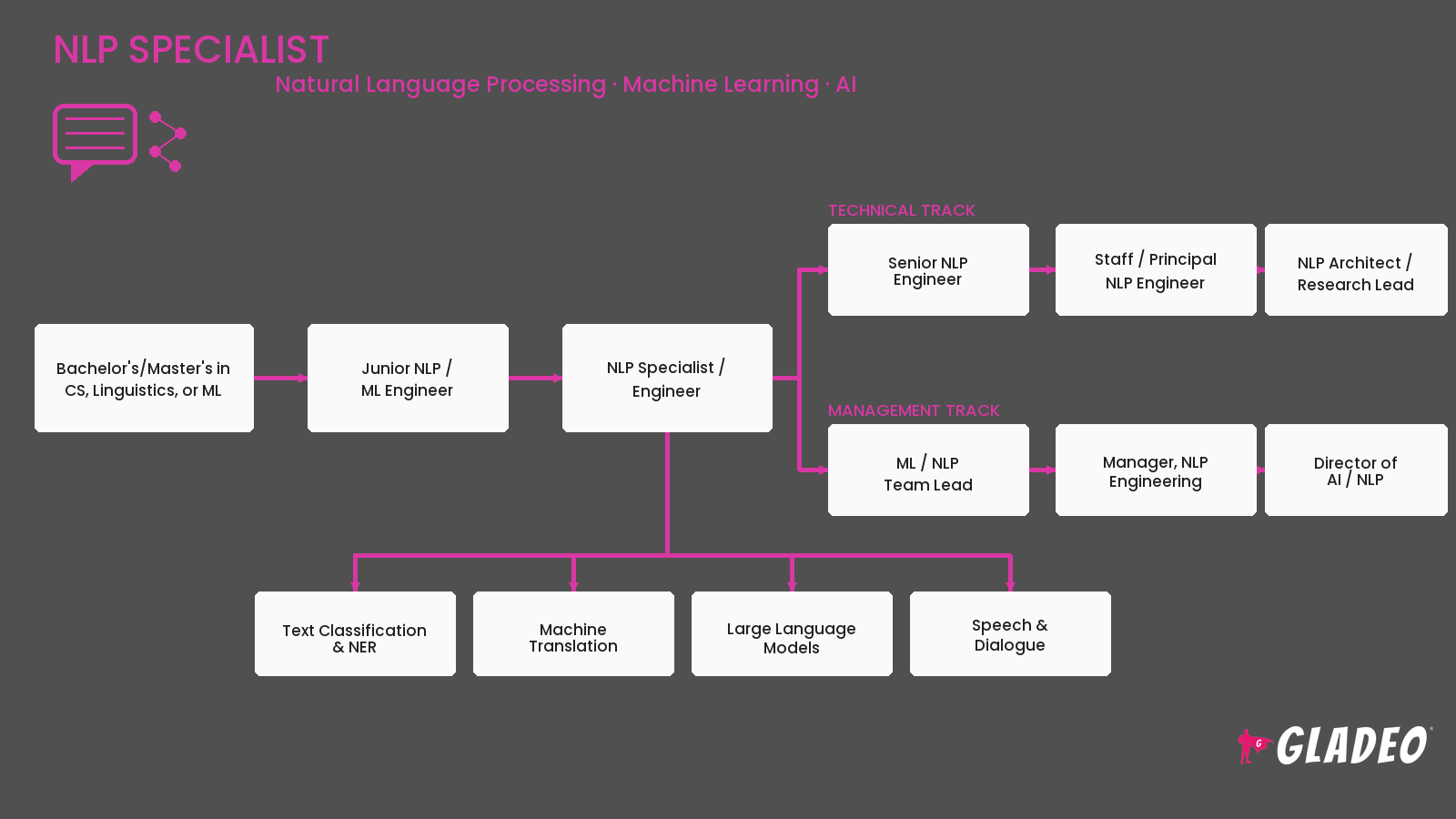
- Build a portfolio of NLP projects, such as a sentiment classifier, translator, or chatbot
- Apply for entry-level titles like NLP Engineer, Junior Data Scientist, or Computational Linguist
- Compete in NLP-focused Kaggle competitions and document your process
- Contribute to open-source NLP libraries like spaCy or Hugging Face Transformers
- Practice explaining a language problem and your solution clearly in interviews
- Network with researchers and engineers through conferences and online communities
- Search job boards for both "NLP" and broader "machine learning" titles
- Highlight any multilingual skills or linguistics background as a real asset
- Consider internships at companies building translation, chatbot, or content moderation tools
- Prepare for technical interviews covering both coding and language-specific concepts
- Be ready to discuss how you would evaluate whether a model truly understands language
- Stay flexible about starting in a broader data science or ML engineering role
- Build a track record of shipping language models that perform well in production
- Develop deep expertise in a specific niche, such as translation, sentiment, or dialogue systems
- Learn to handle multilingual and low-resource language challenges
- Mentor annotators and junior engineers on language and labeling best practices
- Contribute to research papers or present at NLP conferences
- Build strong relationships with linguists and product teams to improve collaboration
- Stay current with new model architectures and techniques as they emerge
- Move into senior NLP engineer, research scientist, or applied AI leadership roles
Websites:
- ACL Anthology - aclanthology.org
- Hugging Face - huggingface.co
- spaCy Documentation - spacy.io
- NLTK - nltk.org
- Papers with Code (NLP) - paperswithcode.com/area/natural-language-processing
- DAIR.AI - dair.ai
- Stanford NLP Group - nlp.stanford.edu
- Google AI Language Blog - ai.googleblog.com
- Kaggle - kaggle.com
- Towards Data Science - towardsdatascience.com
- Speech and Language Processing Companion Site - web.stanford.edu/~jurafsky/slp3
- r/LanguageTechnology - reddit.com/r/LanguageTechnology
Books:
- Speech and Language Processing by Daniel Jurafsky and James H. Martin
- Natural Language Processing with Transformers by Lewis Tunstall, Leandro von Werra, and Thomas Wolf
- Foundations of Statistical Natural Language Processing by Christopher Manning and Hinrich Schütze
- Practical Natural Language Processing by Sowmya Vajjala, Bodhisattwa Majumder, Anuj Gupta, and Harshit Surana
- Deep Learning for Natural Language Processing by Palash Goyal, Sumit Pandey, and Karan Jain
If you find that being an NLP Specialist isn't the right fit, your skills in language, data, and analytical thinking transfer well to many related careers.
- Computational Linguist
- Machine Learning Engineer
- Data Scientist
- Translator or Localization Specialist
- Speech Scientist
- Chatbot Developer
- Data Annotation Lead
- Foreign Language Teacher
- Software Engineer
Click here to download the infographic
Newsfeed

Featured Jobs
Online Courses and Tools